In today’s competitive tech landscape, landing your first Machine Learning job or internship as a fresher can feel overwhelming. But one powerful asset often separates successful candidates from the rest: a well-executed Machine Learning mini project. These small-scale initiatives aren’t just academic requirements—they’re launchpads that demonstrate practical skills, problem-solving ability, and real-world applicability to recruiters.
This comprehensive guide explores how to transform your Machine Learning mini project into a compelling story that opens doors to Machine Learning internships, strengthens your Machine Learning portfolio, and ultimately secures Machine Learning jobs for freshers. Whether you’re a computer science student, data science enthusiast, or self-taught learner, the strategies here will help you stand out.
Section 1: Why Your Machine Learning Mini-Project Is Your Strongest Career Weapon

The gap between classroom theory and industry expectations is wide. Companies hiring for entry-level Machine Learning roles want evidence that you can apply concepts like supervised learning, neural networks, or model deployment—not just recite definitions.
A strong Machine Learning mini project bridges this gap. According to various industry surveys and hiring trends (including insights from LinkedIn and Glassdoor reports on tech recruitment), portfolios with tangible projects increase interview callbacks by 2-3x for freshers. Why?
- Credibility: It proves you can handle end-to-end ML workflows—from data collection to deployment.
- Differentiation: While everyone has coursework, few have polished, documented projects that solve meaningful problems.
- Conversation Starter: In interviews, your project becomes the anchor for behavioral and technical discussions.
- Skill Validation: It showcases proficiency in Python, scikit-learn, TensorFlow/PyTorch, data visualization (Matplotlib/Seaborn), and version control (Git).
For Machine Learning projects for students, the mini-project format is ideal because it’s scoped (typically 2-8 weeks), focused, and achievable alongside academics. It also serves as the foundation for larger contributions, like open-source work or hackathon wins.
Real Impact Example: Many freshers have turned sentiment analysis models or image classifiers into full-time offers at startups and even FAANG-level companies by presenting them effectively during interviews.
Section 2: Selecting the Perfect Machine Learning Mini-Project
Choosing the right project is critical. It should be challenging enough to showcase depth but completable without getting stuck for months.
Criteria for Great ML Mini-Projects for Students:
- Relevance: Align with industry trends (e.g., computer vision, NLP, recommendation systems, predictive analytics).
- Data Availability: Use public datasets from Kaggle, UCI Repository, or Hugging Face.
- Novelty/Twist: Add a unique angle—e.g., deploy as a web app, optimize for edge devices, or incorporate fairness/bias mitigation.
- Scalability: Start simple, then iterate (MVP → enhanced version).
- Impact: Solve a personal, social, or business problem.
Top 10 Machine Learning Mini Project Ideas for Students (2025-2026 Relevant):
- Sentiment Analysis on Social Media – Use Twitter/X or Reddit data with BERT or VADER. Extend to real-time dashboard.
- Image Classification with CNNs – Cats vs Dogs or custom dataset (e.g., Indian food items). Add transfer learning with ResNet.
- House Price Prediction – Regression models on housing datasets. Include feature engineering and SHAP explanations.
- Recommendation System – Collaborative filtering or content-based for movies/books. Deploy with Streamlit.
- Chatbot for FAQs – Rasa or Hugging Face transformers for domain-specific bots (e.g., college admission queries).
- Stock Price Prediction – Time series with LSTM/Prophet. Emphasize limitations and risk disclaimers.
- Facial Expression Recognition – For mental health applications.
- Spam Detection – Email/SMS classification with advanced embeddings.
- Predictive Maintenance for IoT – Simulated sensor data.
- Multimodal Project – Combine text + image (e.g., meme classification or visual question answering).
Pro Tip: For Machine Learning internships, pick projects related to the target company’s domain (healthtech → medical imaging; fintech → fraud detection).
Aim for 3-5 solid projects in your Machine Learning portfolio rather than 20 shallow ones. Quality > Quantity.
Section 3: Step-by-Step Execution of Your ML Mini-Project
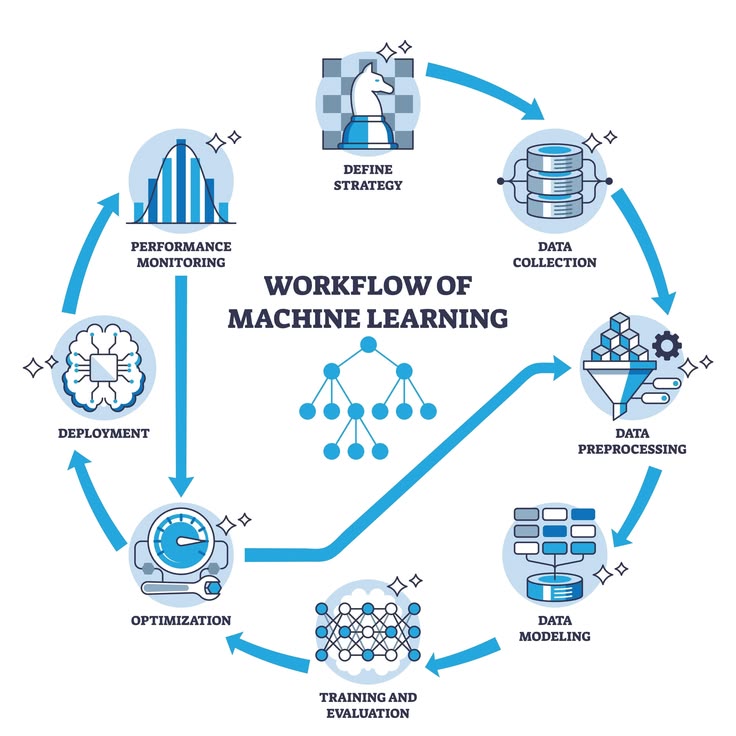
Here’s a detailed blueprint to build a professional-grade project.
Phase 1: Problem Definition & Research (Week 1)
- Clearly state objectives, success metrics (accuracy, F1-score, RMSE, etc.).
- Literature review: Read 3-5 relevant papers on arXiv or Google Scholar.
- Define scope and assumptions.
Phase 2: Data Handling (Week 1-2)
- Collect/clean data (Pandas, handling missing values, outliers).
- Exploratory Data Analysis (EDA): Visualizations, correlations, statistical tests.
- Feature engineering: Scaling, encoding, dimensionality reduction (PCA).
Phase 3: Modeling (Week 2-4)
- Baseline models (Logistic Regression, Random Forest).
- Advanced models (XGBoost, Neural Nets).
- Hyperparameter tuning (GridSearchCV, Optuna).
- Cross-validation to avoid overfitting.
Phase 4: Evaluation & Interpretation
- Metrics + confusion matrices, ROC curves.
- Explainability tools: LIME, SHAP.
- Error analysis: Where does the model fail and why?
Phase 5: Deployment & Polish
- Streamlit, Gradio, or FastAPI for web interface.
- Docker containerization.
- Host on Heroku, Render, Hugging Face Spaces, or Vercel.
- Version control with GitHub (clean README, .gitignore, requirements.txt).
Code Best Practices:
- Modular structure (data/, models/, notebooks/, src/).
- Logging and error handling.
- Unit tests where possible.
Example snippet for a simple classifier:
Python
from sklearn.model_selection import train_test_split
from sklearn.ensemble import RandomForestClassifier
import joblib
# … data loading and preprocessing …
X_train, X_test, y_train, y_test = train_test_split(X, y, test_size=0.2)
model = RandomForestClassifier(n_estimators=100)
model.fit(X_train, y_train)
joblib.dump(model, ‘model.pkl’)
Document challenges faced (e.g., class imbalance) and solutions—these stories shine in interviews.
Section 4: Building a Standout Machine Learning Portfolio
Your Machine Learning portfolio is your digital resume. Treat it like a product.
Essential Components:
- Personal Website: Built with GitHub Pages, Streamlit, or Next.js. Include project cards with live demos, screenshots, and blog-style write-ups.
- GitHub Repository: Professional READMEs with:
- Project title and tagline
- Problem statement & business value
- Dataset description
- Architecture diagram (draw.io or Lucidchart)
- Results (tables, plots)
- Installation & usage instructions
- Future improvements
- LinkedIn: Detailed project descriptions, featured sections, and posts sharing progress.
- Notion or Dev.to Blog: In-depth case studies.
- PDF One-Pager: For quick sharing during applications.
Optimization for SEO & Visibility (relevant to this blog’s theme):
- Use keywords naturally: “This Machine Learning mini project on [topic] helped me understand…”
- Add tags on GitHub/Kaggle.
- Contribute to related repos or write tutorials.
Aim for diversity: one supervised, one unsupervised, one deployment-heavy, and one research-oriented project.
Section 5: Leveraging Projects for Machine Learning Internships
Machine Learning internships are the best stepping stones. Here’s how your mini-project accelerates this:
- Application Strategy: Tailor resume to highlight project metrics. Use exact keywords from job descriptions (ATS-friendly).
- Cover Letters: Narrate the journey: “My sentiment analysis Machine Learning mini project achieved 92% accuracy and taught me production considerations…”
- Platforms: LinkedIn, Internshala, AngelList, company career pages, Handshake (for campus).
- Cold Outreach: Message recruiters or engineers with a short project summary + GitHub link.
- Hackathons & Competitions: Kaggle, MLH, Smart India Hackathon—great for visibility.
During internships, volunteer to extend your mini-project or integrate it into team workflows. Many converts turn internships into pre-placement offers (PPOs).
Timeline for Freshers:
- Year 2-3: Build 2-3 projects.
- Summer: Apply aggressively for internships.
- Year 4: Use internship experience + enhanced projects for full-time roles.
Section 6: Cracking Machine Learning Jobs for Freshers
Machine Learning jobs for freshers exist—focus on startups, product companies, and roles like ML Engineer (Associate), Data Scientist (Junior), or AI Engineer.
Resume Crafting:
- One-page format.
- Projects section with quantifiable impact first.
- Skills: Python, ML frameworks, cloud (AWS/GCP basics), SQL.
- Education + relevant coursework.
Interview Preparation:
- Project Deep Dive: Expect “Walk me through your best Machine Learning mini project.” Prepare STAR method (Situation, Task, Action, Result).
- Technical: Explain trade-offs (why Random Forest over Neural Net?), deployment challenges, scaling issues.
- Behavioral: Teamwork, learning agility, handling failures.
- System Design Lite: How would you productionize your model?
- LeetCode/HackerRank: Medium-level coding + ML-specific questions.
Common Questions:
- How did you handle imbalanced data?
- What would you do differently now?
- How does your project address ethical concerns (bias, privacy)?
Mock Interviews: Pramp, Interviewing.io, or peers.
Section 7: Networking, Personal Branding & Advanced Tips
- LinkedIn Optimization: Professional photo, banner mentioning “Aspiring ML Engineer | 4+ ML Projects”, regular posting of project updates.
- Communities: Reddit (r/MachineLearning, r/LearnMachineLearning), Discord servers, local meetups, Twitter/X ML circles.
- Open Source: Contribute to beginner-friendly ML repos.
- Blogging: Write tutorials based on your projects—this builds authority and SEO traffic.
- Certifications: Google Professional ML Engineer, Coursera specializations (as supplements, not replacements for projects).
Advanced Enhancements:
- MLOps: CI/CD with GitHub Actions, monitoring with MLflow.
- Cloud Integration: AWS SageMaker or Vertex AI experiments.
- Research Angle: Replicate a paper and document improvements.
Overcoming Common Pitfalls:
- Overly ambitious scope → Start small, iterate.
- Poor documentation → Recruiters spend <30 seconds initially.
- No deployment → Static notebooks look amateur.
- Ignoring soft skills → Communication is key.
Section 8: Success Stories & Case Studies

Story 1: Priya, a Tier-2 college student, built a crop disease detection app using CNNs. She documented it extensively, deployed on Hugging Face, and shared on LinkedIn. This landed her a Machine Learning internship at an agritech startup, which converted to a full-time role.
Story 2: Rahul focused on NLP for regional language sentiment analysis (a unique Indian context twist). His project impressed during campus placements and secured an offer from a fintech unicorn.
These aren’t anomalies—consistent effort with strategic presentation works.
Metrics to Track:
- GitHub stars/forks.
- Project demo views.
- Application response rates (aim to improve iteratively).
Section 9: Resources & Roadmap for Continuous Growth
- Learning Platforms: fast.ai (practical), Coursera (Andrew Ng), Kaggle courses.
- Books: “Hands-On Machine Learning with Scikit-Learn, Keras, and TensorFlow” by Aurélien Géron.
- Tools: VS Code, Jupyter, Git, Weights & Biases for experiment tracking.
- 6-Month Roadmap:
- Month 1-2: Core concepts + first project.
- Month 3-4: Advanced models + portfolio site.
- Month 5: Internships/applications.
- Month 6: Interview prep + side contributions.
Stay updated with arXiv weekly digests and conferences like NeurIPS (watch recordings).
MLOps Deployment Strategies: From Mini-Project to Production-Ready ML Systems
In the context of turning your Machine Learning mini project into a career asset, mastering MLOps deployment strategies is what separates a strong portfolio piece from something truly impressive to recruiters. While building and training a model is valuable, demonstrating how you’d take it to production—reliably, scalably, and maintainably—shows engineering maturity that Machine Learning jobs for freshers and Machine Learning internships demand.
MLOps applies DevOps principles (automation, versioning, CI/CD, monitoring) to the ML lifecycle. Deployment is one of the most critical (and challenging) stages, as 85%+ of models never reach production without proper practices.
Core MLOps Deployment Patterns
Here are the primary deployment strategies suited for different use cases, especially relevant for student/fresher projects:
- Batch Inference (Offline / Periodic Predictions)
- Description: Predictions run on scheduled batches of data (e.g., nightly job scoring thousands of records). Results are stored in a database or used for downstream processes.
- Best For: Recommendation systems (daily user recommendations), fraud reports, predictive maintenance, or bulk image processing.
- Advantages: Cost-effective, easier to scale, handles large volumes, less latency pressure.
- Implementation:
- Use Apache Airflow, Prefect, or Kubeflow Pipelines for orchestration.
- Tools: AWS Batch, Google Cloud Dataflow, or simple cron jobs with Python scripts.
- Store predictions in S3 + database.
- For Mini-Projects: Extend your house price predictor to run batch inference on new listings weekly. Show scheduling and result storage in your GitHub README.
- Real-Time / Online Inference (Synchronous Serving)
- Description: Model serves predictions instantly via API calls (low latency, often <100ms).
- Best For: Chatbots, fraud detection during transactions, dynamic pricing, image classification in apps.
- Implementation Options:
- REST/gRPC APIs: FastAPI + Uvicorn for simple serving.
- Containerized: Docker + Kubernetes (most common for scalability).
- Managed Services: AWS SageMaker Endpoints, Google Vertex AI, Azure ML.
- Frameworks: BentoML, Seldon Core, TorchServe, or KServe.
- Advanced Patterns:
- Blue-Green Deployments: Run old + new model versions; switch traffic after validation.
- Canary Releases: Route small % of traffic to new model; monitor before full rollout.
- A/B Testing: Compare model variants for business metrics (not just accuracy).
- For Students: Deploy your sentiment analysis model as a FastAPI endpoint on Render/Hugging Face Spaces. Add auto-scaling and basic monitoring.
- Asynchronous / Near Real-Time Inference
- Queues requests (e.g., via SQS or Kafka) for processing when resources are available. Good balance for spiky traffic.
- Edge / On-Device Deployment
- Description: Model runs locally on devices (phones, IoT, browsers) with minimal cloud dependency.
- Best For: Privacy-sensitive apps, low-connectivity scenarios, real-time video (e.g., facial recognition).
- Tools: TensorFlow Lite, ONNX Runtime, PyTorch Mobile, CoreML.
- Optimization: Quantization, pruning, distillation to reduce model size/latency.
- For Mini-Projects: Convert your CNN image classifier to TensorFlow Lite and demo on a mobile app or browser (WebAssembly). This stands out heavily in portfolios.
- Serverless Deployment
- Description: Pay-per-inference with auto-scaling (no server management).
- Tools: AWS Lambda + container images, Google Cloud Run, Azure Functions.
- Pros: Low ops overhead, great for variable traffic.
- Cons: Cold starts, limited GPU support for heavy models.
- Use Case: Prototypes or low-to-medium volume APIs.
Key MLOps Best Practices for Deployment (2026)
- Version Everything: Code (Git), data (DVC), models (MLflow Model Registry or Hugging Face), environments (Dockerfiles).
- CI/CD for ML: Automate testing (unit + model validation), building, and deployment with GitHub Actions, GitLab CI, or Jenkins.
- Model Registry: Central place to store, version, and promote models (MLflow, SageMaker Model Registry).
- Monitoring & Drift Detection: Track data drift, concept drift, performance degradation. Tools: Evidently AI, WhyLabs, Prometheus + Grafana.
- Feature Stores: Ensure consistency between training and serving (Feast, Tecton).
- Reproducibility & Testing: Automated gates for data validation and model evaluation before promotion.
- Security & Governance: Model cards, bias/fairness checks, compliance (especially for regulated industries).
- Rollback Plans: Always have mechanisms to revert to previous model versions quickly.
Recommended Tooling Stack for Freshers / Students
Lightweight (Ideal for Mini-Projects):
- Tracking: MLflow
- Serving: BentoML or FastAPI + Docker
- Orchestration: Prefect or simple GitHub Actions
- Hosting: Hugging Face Spaces, Render, Fly.io, or local-to-cloud with Docker
Production-Grade:
- Kubeflow (Kubernetes-native pipelines)
- Seldon Core / KServe for advanced serving
- Cloud-managed: AWS SageMaker, Vertex AI (great for learning managed MLOps)
Example End-to-End Flow:
- Train → Log with MLflow.
- Register best model.
- CI/CD triggers container build.
- Deploy to Kubernetes or SageMaker with canary strategy.
- Monitor with Evidently; trigger retraining on drift.
How to Showcase This in Your Portfolio & Interviews
For your Machine Learning portfolio:
- Add a dedicated “MLOps & Deployment” section.
- Include architecture diagrams (e.g., training → registry → serving endpoint → monitoring).
- Live demo links + cost/latency metrics.
- Blog post or README detailing challenges (e.g., “Overcame cold starts by switching to provisioned concurrency”).
- Compare strategies: “Chose batch for this project because… but would use real-time for a user-facing app.”
In Machine Learning internships or job interviews:
- Expect questions like: “How would you productionize this model?” or “Explain model drift and how you’d handle it.”
- Discuss trade-offs: latency vs. cost, batch vs. real-time, on-prem vs. cloud vs. edge.
- Highlight any hands-on experience—even a simple Streamlit + backend deployment counts.
Challenges & Future Trends (2026)
- LLMOps: Adapting strategies for large language models (prompt management, RAG serving, cost optimization).
- Multi-Model Serving: Hosting multiple models efficiently on shared infrastructure.
- Sustainability: Energy-efficient inference and green AI practices.
- Automation Maturity: From manual deployments to fully autonomous retraining pipelines.
Adding MLOps elements to your Machine Learning mini project dramatically boosts its impact. Even starting small—containerizing your model and deploying it with basic CI/CD—will make you far more prepared for real Machine Learning jobs for freshers.
Actionable Next Step: Take one of your existing projects, dockerize it, serve it with BentoML or FastAPI, and deploy to a free tier platform. Document the process thoroughly.
If you want a specific code example (e.g., FastAPI + MLflow serving template, Kubernetes manifests, or SageMaker deployment script), a diagram, or help integrating this into your full blog post, let me know! This knowledge directly strengthens your path from college project to career offer.
Conclusion: Your Project, Your Future
Turning a Machine Learning mini project into a job offer isn’t about luck—it’s about deliberate execution, storytelling, and persistence. By building high-quality Machine Learning projects for students, curating an impressive Machine Learning portfolio, targeting relevant Machine Learning internships, and preparing thoroughly for Machine Learning jobs for freshers, you position yourself as a proactive, capable candidate.
Start today. Pick one idea from the list, commit to finishing it excellently, and share your progress. The journey from college project to career is real—and yours can begin with that first commit.
The tech industry needs passionate problem-solvers. Your Machine Learning mini project might just be the key that unlocks your dream opportunity.
FAQ
1. Why is an ML mini-project important for getting a job?
A machine learning mini-project demonstrates your practical skills, problem-solving ability, and understanding of real-world AI concepts, making your resume more attractive to recruiters.
2. What type of ML projects do recruiters prefer?
Recruiters prefer projects that solve real-world problems, use clean datasets, apply appropriate algorithms, and clearly explain the results and business impact.
3. Can a college mini-project help me get placed?
Yes. A well-documented and practical ML project can showcase your technical expertise during interviews and significantly improve your placement opportunities.
4. Which machine learning project topics are best for beginners?
Popular beginner-friendly topics include spam email detection, house price prediction, sentiment analysis, disease prediction, recommendation systems, and customer churn prediction.
5. How should I present my ML project during an interview?
Explain the problem statement, dataset, data preprocessing, algorithms used, model evaluation, challenges faced, and the project’s real-world applications.