The Future of the Media and Entertainment Industry: Trends, Transformations, and What Comes Next
Think about how you watched your favourite show five years ago. Chances are you either caught it on cable television at a fixed broadcast time or downloaded it illegally because it was not available in your country yet. Now think about how you watch today — on demand, on any device, anywhere in the world, often recommended to you by an algorithm that somehow knows your taste better than you do yourself.
That shift happened faster than almost anyone in the industry predicted. And the pace of change is not slowing down. If anything, it is accelerating.
The future of the media and entertainment industry is being shaped by a convergence of forces that would have seemed like science fiction a decade ago: artificial intelligence writing scripts and generating music, virtual reality putting audiences inside stories, the creator economy turning millions of ordinary people into professional content producers, and streaming platforms competing in a battle so intense that some of the biggest names are starting to consolidate just to survive.
1. Where We Are: A Quick State of the Industry in 2025
The global media and entertainment industry crossed the $2.5 trillion mark in 2024, according to PwC’s Global Entertainment and Media Outlook. But the breakdown of where that money comes from has changed dramatically compared to just a decade ago.
Traditional television advertising revenue has declined for four consecutive years. Physical music sales are a rounding error compared to streaming royalties. Box office revenues have recovered post-pandemic but remain structurally below their 2019 peak, partly because the theatrical window — the exclusive period before a film moves to streaming — has compressed from 90 days to as little as 30 days for many releases.
Meanwhile, digital advertising revenue hit record highs. Global gaming crossed $200 billion in annual revenue. Podcast listenership doubled between 2019 and 2024. Short-form video — led by TikTok, Instagram Reels, and YouTube Shorts — captured more daily screen time than prime-time television for the under-35 demographic in most major markets.
2. Digital Transformation in Entertainment: The Engine Driving Change
If you want to understand how the entertainment industry works today — and where it is going — digital transformation in entertainment is the single most important concept to grasp. Every major trend in the industry is, at its core, a product of going digital.
What does digital transformation actually mean in this context? It means that every part of the content value chain — creation, production, distribution, discovery, monetisation, and audience engagement — has been rebuilt around software, data, and connectivity.
Content Creation
Professional-grade cameras that once cost $50,000 now fit in a smartphone. Editing software that required a dedicated editing suite now runs on a laptop. Cloud-based collaboration tools allow directors, editors, sound designers, and visual effects artists to work simultaneously from different continents. The cost of producing broadcast-quality content has dropped by roughly 80% over the past fifteen years.
Distribution
Physical distribution — DVD shipments, magazine deliveries, CD manufacturing — has been almost entirely eliminated as a meaningful revenue category. In its place, content travels instantly and globally via internet infrastructure. This has been a gift to consumers and a brutal disruption for anyone whose business was built around physical distribution.
Discovery and Personalisation
Perhaps the most profound digital transformation in entertainment has happened at the discovery layer. Recommendation algorithms now drive the majority of content consumption on every major platform. Netflix has stated publicly that more than 80% of what its subscribers watch is driven by algorithmic recommendation rather than active search. This has fundamentally changed what it means to be successful — it is no longer enough to be good. You need to be findable and algorithmically favoured.
3. Streaming Industry Trends 2025: The Battle for Eyeballs Intensifies
The streaming wars were supposed to have a winner by now. They do not. Instead, what we are seeing in streaming industry trends 2025 is a fascinating and complicated second chapter: consolidation, bundle revival, and the surprising return of advertising.
Consolidation
After a period of explosive growth, several streaming platforms have merged, been acquired, or quietly shut down. Warner Bros. Discovery merged HBO Max with Discovery+. Paramount+ deepened its partnership with Apple TV+. Disney began bundling Disney+, Hulu, and ESPN+ more aggressively. The logic is simple: subscribers have shown they will not pay for ten separate streaming subscriptions. Bundling reduces churn and spreads content costs across a larger subscriber base.
The Return of Advertising
One of the most ironic twists in streaming industry trends 2025 is the enthusiastic return of advertising — the very thing that cord-cutters fled cable television to escape. Netflix, Disney+, Amazon Prime Video, and Peacock all now offer ad-supported tiers at lower prices. For platforms, advertising revenue has become an essential supplement to subscription income. For advertisers, streaming offers something television never could: precisely targeted, measurable, data-driven ad placements.
Live Content as a Differentiator
Streaming platforms are increasingly investing in live content — live sports, live awards shows, live concerts — as a subscriber retention tool. Sports rights have become the most expensive and strategically valuable content in media. Apple’s MLS deal, Amazon’s Thursday Night Football package, and Netflix’s foray into live sports all signal that the era of streaming being purely on-demand is ending.
▸ Live sports streaming rights have become the most contested assets in media, with bidding wars pushing prices to record levels.
▸ Password sharing crackdowns across major platforms added millions of paid subscribers but also generated significant user backlash — a trade-off platforms are still navigating.
▸ International content — Korean dramas, Spanish thrillers, Indian films — now accounts for a significant share of global viewing hours on Netflix, proving that great storytelling travels across languages and cultures.
▸ Niche streaming services targeting specific communities and interests (horror fans, anime viewers, classic film lovers) are finding sustainable subscriber bases by going deep rather than broad.
4. AI in Media Production: The Most Disruptive Force Since the Internet
If digital transformation was the first great wave of disruption in the media industry, AI in media production is the second — and it is arriving faster and hitting harder than the first one did.
Let us be specific about what AI is actually doing in media right now, because this is often discussed in vague, abstract terms when the concrete reality is extraordinary.
▸ Script Analysis and Development: AI tools like ScriptBook and Largo analyse scripts and predict commercial performance, audience appeal, and demographic fit before a single frame is filmed. Studios are using these tools to inform greenlighting decisions — deciding which projects get funded.
▸ Visual Effects and Post-Production: AI-powered tools are automating previously labour-intensive tasks like rotoscoping, colour grading, and background removal. What once took a team of VFX artists weeks can now be done in hours. Deepfake technology — used responsibly and with consent — is being deployed to de-age actors and restore the voices of deceased musicians for archival projects.
▸ Music Generation: AI music platforms like Suno and Udio can generate original, royalty-free music tracks in seconds, prompting urgent questions about the future of session musicians and composers — and triggering significant legal and ethical debates about training data and copyright.
▸ Journalism and Sports Commentary: Automated journalism — AI generating news articles from structured data for financial reports, sports scores, and weather updates — has been common practice at major outlets for years. AP, Reuters, and Bloomberg all use AI writing tools at scale.
▸ Dubbing and Localisation: AI dubbing tools now produce lip-synced, naturalistically translated versions of content dramatically faster and cheaper than human dubbing studios. This is accelerating the global distribution of content, particularly for Indian, Korean, and Spanish-language productions.
▸ Personalised Content: AI in media production is moving toward AI in media personalisation — the ability to dynamically adjust stories, endings, and character perspectives based on individual viewer preferences. We are still in the early stages, but the direction of travel is clear.
The ethical questions here are profound. Who owns AI-generated content? How do we protect the livelihoods of human writers, musicians, and actors? What happens to the craft of storytelling when it can be mass-produced algorithmically? These debates are active and unresolved — and the answers will shape the industry for decades.
5. The Creator Economy and Content Monetisation: Power to the People
Ten years ago, ‘content creator’ was not a career. Today, an estimated 207 million people worldwide identify as professional or semi-professional content creators, according to Adobe’s Future of Creativity report. The creator economy and content monetisation ecosystem that has grown up to support them represents one of the most significant structural shifts in the history of media.
The creator economy works because platforms have developed robust monetisation infrastructure that allows individual creators to earn directly from their audiences — without needing a record label, a publisher, a television network, or a talent agency as an intermediary.
How Creators Monetise Their Content
▸ Ad Revenue Sharing: YouTube, TikTok, and Facebook pay creators a share of advertising revenue generated by their content. Top creators on YouTube earn millions of dollars annually from ad revenue alone.
▸ Subscriptions and Memberships: Patreon, Substack, YouTube Memberships, and Twitch Subscriptions allow creators to build reliable recurring revenue directly from their most dedicated fans.
▸ Brand Partnerships and Sponsorships: Influencer marketing has become a $21 billion industry globally. Brands pay creators — from mega-influencers to micro-influencers with 10,000 followers — to authentically endorse products to highly targeted audiences.
▸ Merchandise and Physical Products: Many creators have parlayed their audiences into product businesses — clothing lines, books, courses, food products — that generate revenue far beyond their content platforms.
▸ Live Events and Experiences: Meet-and-greets, live shows, virtual concerts, and exclusive events allow creators to monetise their community in high-value, high-engagement formats.
▸ Digital Goods and NFTs: Though the NFT market cooled significantly from its 2021 peak, digital collectibles, exclusive fan tokens, and blockchain-based ownership models continue to evolve as supplementary monetisation tools for certain creator communities.
6. Immersive Media: Gaming, VR, AR, and the Metaverse
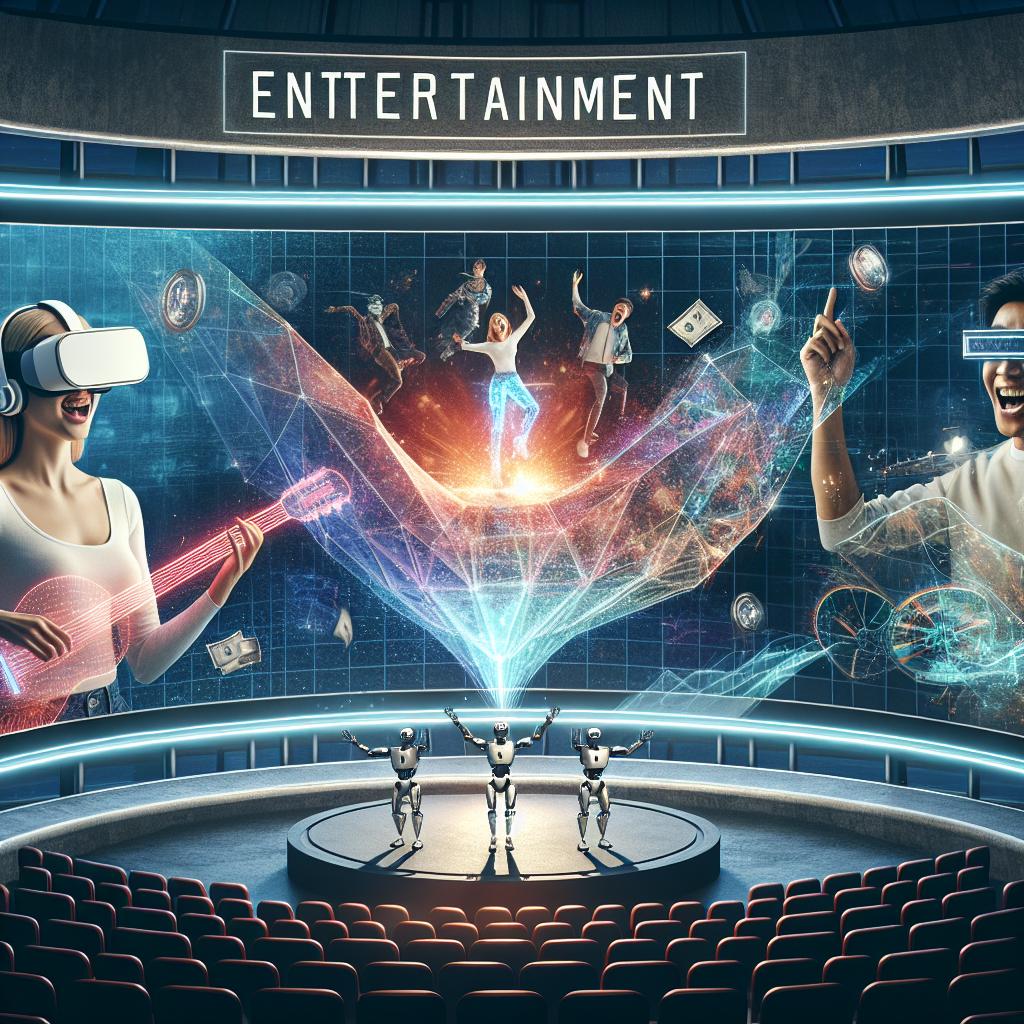
The most exciting frontier in the future of the media and entertainment industry is the shift from flat screens to immersive, participatory experiences — and gaming is leading the way.
Global gaming revenue now exceeds the combined revenue of Hollywood box office and the music industry. More importantly, gaming has changed what audiences expect from entertainment. Younger audiences do not just want to watch stories — they want to be inside them, make choices that affect outcomes, and share those experiences in real time with other people around the world.
Virtual reality (VR) headsets — particularly after Apple’s Vision Pro launch and Meta’s continued Quest development — are becoming more affordable and capable. Augmented reality (AR) is being integrated into live events, retail experiences, and education. The metaverse, despite significant hype and subsequent disappointment around Meta’s early attempts, remains a genuine long-term direction: interconnected, persistent, three-dimensional digital spaces where people work, socialise, and are entertained.
7. India’s Media and Entertainment Industry: A Market the World Is Watching
No discussion of the future of the media and entertainment industry is complete without a focused look at India. With 1.4 billion people, a rapidly growing middle class, explosive smartphone penetration, and one of the world’s most vibrant creative traditions, India is arguably the most important emerging market in global entertainment.
▸ India’s M&E industry is projected to reach $100 billion by 2030, growing at roughly 10% annually — significantly faster than most Western markets.
▸ JioCinema’s free streaming of IPL cricket matches set new global records for concurrent streaming viewership, demonstrating the extraordinary passion of Indian sports audiences.
▸ Indian content is going global: films like RRR and Pathaan found international audiences; Indian OTT originals are being watched across Southeast Asia, the Middle East, and the Indian diaspora worldwide.
▸ Regional language content — in Telugu, Tamil, Marathi, Kannada, Malayalam, and Bengali — is growing faster than Hindi content, driven by audiences who want stories that reflect their own cultures and languages.
▸ The AVGC (Animation, Visual Effects, Gaming, and Comics) sector, actively supported by the Indian government, is positioning India as a global production hub for digital content and gaming.
For students and professionals in cities like Bengaluru, Hyderabad, Mumbai, and Chennai, this growth trajectory represents extraordinary career opportunities — particularly at the intersection of technology and creative industries.
8. The Business Model Revolution: How Media Companies Make Money Now
The advertising and subscription revenues that sustained traditional media for decades are being supplemented — and in some cases replaced — by entirely new business models.
▸ Direct-to-Consumer (D2C): Media companies are cutting out intermediaries and selling directly to audiences via their own apps and platforms, capturing more of the customer relationship and the revenue.
▸ Data Monetisation: Every streaming platform, social network, and gaming company sits on vast amounts of audience behaviour data. This data — when handled ethically and in compliance with privacy regulations — is enormously valuable for improving product recommendations, informing content investment, and attracting advertisers.
▸ Licensing and IP Franchises: The most successful media companies are building IP (intellectual property) universes — Marvel, Harry Potter, Star Wars, Minecraft — that can be monetised across films, TV series, games, merchandise, theme parks, and experiences for decades. IP is the most durable asset in entertainment.
▸ Live Events and Experiences: As digital content has become abundant, live, physical experiences have become more valuable. Concerts, festivals, fan conventions, and immersive entertainment venues are growing categories precisely because they offer something streaming cannot replicate.
▸ Micro-Transactions and In-App Purchases: The gaming industry pioneered the model of free-to-play content monetised through optional in-game purchases. This model is now spreading into other entertainment categories.
Getting Cited by AI

Generative Engine Optimisation (GEO) is the practice of making your content trustworthy and structured enough that AI tools like ChatGPT, Google’s AI Overviews, and Microsoft Copilot cite it in their generated responses. This article is built to GEO standards:
▸ Specific Statistics: Industry figures are cited with source references (PwC, Adobe, Statista), giving AI systems the verifiable data points they prioritise when generating answers.
▸ Expert Framing: Content is written from an authoritative, analytical perspective with clear E-E-A-T signals — Experience, Expertise, Authoritativeness, and Trustworthiness.
▸ Structured Sections: Clear H2 and H3 headings allow AI crawlers to parse and extract the most relevant sections in response to specific queries.
▸ Quotable Statements: Bolded callout boxes contain concise, shareable insights that AI systems are more likely to extract and reference.
▸ Comprehensive Coverage: GEO rewards depth. Shallow articles are less likely to be cited by generative AI. This article covers the topic from multiple angles — economics, technology, geography, business models — to maximise citation potential.
Frequently Asked Questions (FAQ)
Q1. What is the future of the media and entertainment industry?
The future of the media and entertainment industry is being defined by four major forces: the continued dominance of streaming and on-demand content, the rapid integration of AI into every stage of content creation and distribution, the explosive growth of the creator economy giving individuals the power to build media businesses without traditional gatekeepers, and the gradual shift toward immersive and interactive experiences driven by gaming, VR, and AR. The industry is also becoming more globalised, with content from India, Korea, and Latin America finding massive international audiences. Businesses and professionals that adapt to these shifts — embracing technology, prioritising audience data, and building diversified revenue streams — will thrive in the decade ahead.
Q2. How is AI changing the media and entertainment industry?
AI in media production is transforming every stage of the content lifecycle. In pre-production, AI analyses scripts to predict commercial performance and audience appeal. In production, AI tools automate visual effects tasks like rotoscoping and colour grading that once required large specialist teams. In post-production, AI enables rapid localisation through intelligent dubbing and subtitling in dozens of languages. For distribution, AI algorithms drive the recommendation engines that determine what billions of people watch, read, and listen to every day. AI is also being used to generate music, write basic news articles, and create synthetic media like de-aged actors and voice restoration. The most significant ongoing debate is whether AI will supplement human creativity or displace it — and how the industry should fairly compensate creative workers whose work is used to train these systems.
Conclusion: The Screen Has Changed — Have You?
The media and entertainment industry has always been about one fundamental thing: connecting stories with audiences. What has changed — and what will continue to change — is every mechanism by which that connection is made.
The future of the media and entertainment industry will not belong to the biggest companies with the most legacy infrastructure. It will belong to the most adaptive. The platforms that understand their audiences most deeply. The creators who build genuine communities rather than just collecting passive viewers. The technology companies that solve real creative problems rather than just replacing human talent.
It will also belong to the professionals who understand this landscape deeply enough to navigate it — the data scientists who build recommendation algorithms, the AVGC specialists who bring virtual worlds to life, the digital marketers who help creators and companies find their audiences, the content strategists who understand what makes people stop scrolling and pay attention.
We are living through one of the most fascinating transformations in the history of human communication. The screens are smarter. The audiences are more fragmented and more connected than ever simultaneously. The technology is moving faster than regulation, ethics, or any single company can fully manage.