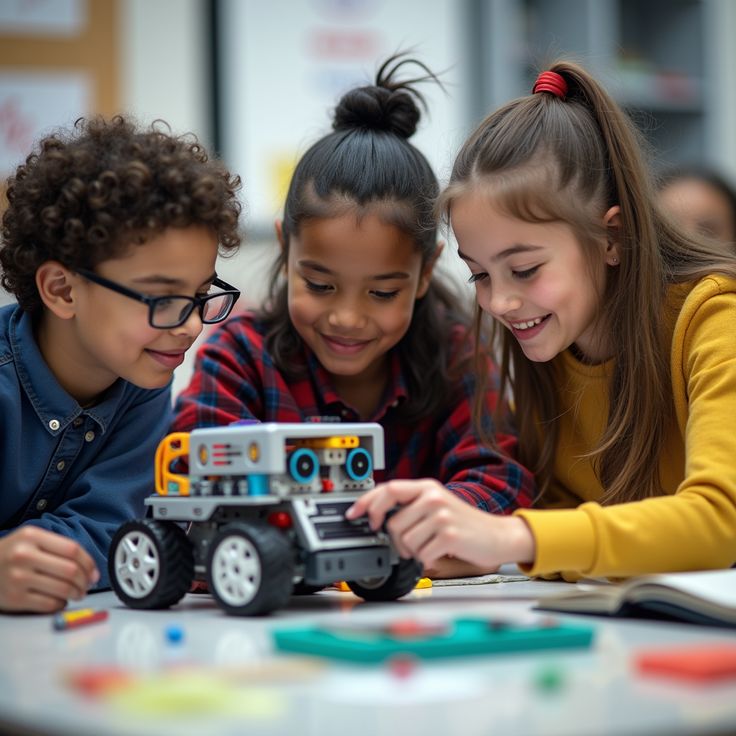
Have you imagined your child representing their school in a nationwide robotics competition while still being a student?
Ten years back, watching robotics in movies and visiting engineering schools was the only way a lot of children got exposed to robotics. Now, with the ability to design autonomous systems, program machines, and address real-world problems, children of school-going age are competing in and winning national robotics competitions.
Robotics competitions are becoming an important avenue in schools across India for children to showcase their creativity, innovation, and teamwork, and develop their technical skills. Schools are encouraging participation in these competitions as they help children develop skills related to the future workforce that are not taught in schools.
This is the reality many parents are dealing with.
With children getting curious about technology, and the gadgets they use daily, and with aspirations of building robots, there are very few avenues to provide children the needed guidance and exposure. Schools are introducing STEM, but children are still very much lacking the access to robotics needed for the competitions.
This is the gap that Rapid AI 360 is meeting.
With a relevant curriculum, guided mentorship, and a focus on project-based learning, Rapid AI 360 is equipping students with the skills to not only participate in robotics competitions, but to compete at a national level and do so with confidence.
In this blog, we will discuss the importance of robotics competitions, the challenges faced by students, and how the programs offered by Rapid AI 360 help innovators with the skills and tools they need to be successful.
Why Are Robotics Competitions Becoming Popular in India?
Rapid development and adoption of new technologies such as AI, Automation, Robotics, the IoT, and Machine Learning is making India a competitive player in the global market. However, in order to stay competitive, schools have to adapt and ensure a technology driven future.
Robotics competitions are a great opportunity for students at the national level to:
Make classroom learning applicable to the real world
Create original strategies
Understand the value of cooperation and leadership
Gain presentation confidence
Tackle real engineering problems
Engage in creative thinking while under time constraints
Each of these skills and traits will serve students in the workforce and are generally more useful than the skills reinforced by traditional testing.
The Challenge: Why Students in Robotics Competitions are Typically Less Successful
Thousands of students participate in robotics competitions every year.
Unfortunately, a large majority of participants are unsuccessful.
The likely reason for this is that competitive robotics is much more than putting together a kit. Students must be knowledgeable in:
The principles of robotics, electronics, programming, mechanical design, AI, logical thinking, and teamwork
Not to mention the ability to present and manage time well.
This is the reason that many schools are unable to help students at higher levels of robotics.
This has led to many gifted students participating in robotics competitions for the sake of doing so.
The outcome of this is lost opportunities and a lack of progress and learning.
The Solution: Learn Robotics by Doing
The most effective way to learn robotics is not with the aid of a textbook, but rather by doing.
The best way to learn robotics is by:
Designing a robot
Building it
Writing the code
Testing it out
Identifying the errors
Improving the design
Presenting it
Each project continues to educate participants and develop their confidence.
Learning by doing is the best way to make theory and practice come together.
This is the main goal of Rapid AI 360.
Why Practical Learning is Important
How well do you think you could ride a bike if all you had ever done was read books about riding a bike?
The same is true for robotics.
Students gain the confidence to build by attempting it themselves, failing, and trying again.
Hands-on activities teach
Critical Thought
Creativity
The Engineering Mindset
Problem Solving
Decision Making
Communication
Collaboration
All these skills go beyond the field of robotics, helping the student flourish in school and the workplace.
Why are National Robotics Competitions Unique?
Robotics competitions, unlike school science fairs, are true representations of engineering challenges.
Students must:
Build a robot to solve a specific challenge
Create a system that works on its own or with little help
Work under time limits
Work as a team
Implement their solution and keep making improvements
Exhibit their design to the judges
These challenges help students begin to understand engineering at its core and think creatively to solve the challenges of the industry.
Robotics Competitions Teach Children Various Skills
Robotics competitions help develop a range of life skills blended with the technical skills.
Technical Skills
Robotics
Programming
Electronics
Sensors
AI
Automation
Engineering
IoT
Soft Skills
But just as important are the skills learned at the competition that are related to:
Leadership
Teamwork
Communication
Time management
Creativity
Confidence
Analytical Thinking
Presentation skills
Students learn these skills that prepare them for the competitions, post-secondary education, and help them in their future careers.
Why are Early Robotics Programs Important for Your Children?
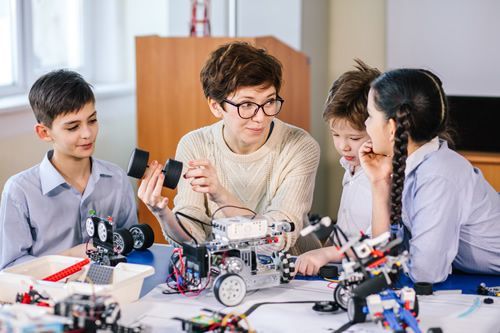
Many parents think robotics is only for engineering based careers.
That is far from the truth.
Children learn and grow naturally by building and experimenting to solve problems.
Introducing robotics as early as possible provides children with the opportunity to:
Safely explore technology
Enhance logic
Build on math fluency
Learn coding
Boost creativity
Establish confidence by building and designing
Getting kids passionate about robotics early has the added benefit of letting them discover their interests early on as they make their educational decisions in the future.
Robotics Is More Than Machines
When the public thinks of a robot, the machine that comes to mind is a human-like machine.
That is an outdated view of robotics.
Now students can work on:
Smart Cars
Automated irrigation systems
Robots for healthcare
Home Automation
Disaster relief response robots
Smart cities
Environmental robots
Automation for Industry
Robotics work in all of these fields.
How Rapid AI 360 Builds Future Innovators
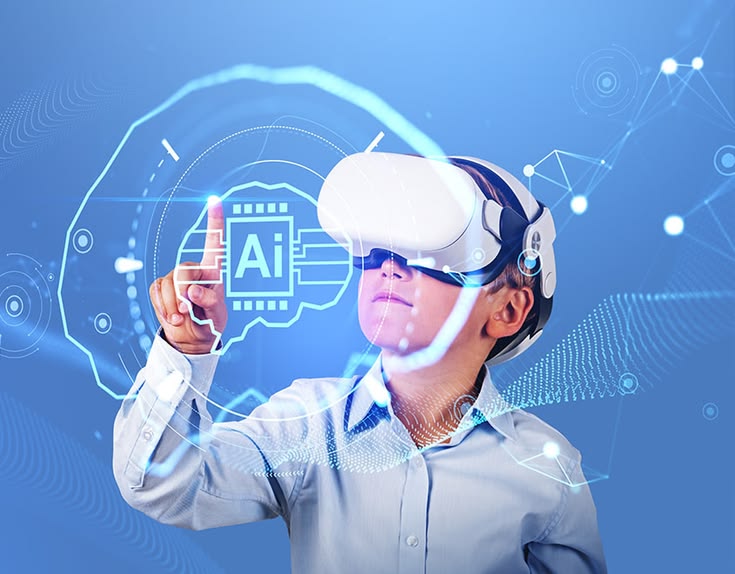
At Rapid AI 360, we want students to create and play and learn to solve real world problems.
To help achieve this, we have designed education that includes a lot of activity based learning and little to no lecture.
Students learn from a progression of activities that incorporate a lot of play and learning in the process.
Teaching robotics is only a small part of their work.
We want to inspire students to become innovators and help them develop the confidence to do it.
Learning Beyond the Classroom
At Rapid AI 360, we have taken robotics education beyond school.
Students do the work of:
Innovators
Team builders
Designers
Coders
AI practice
Prototyping
Robotics simulation
Competitions
All of this work helps students gain new knowledge and strengthens their confidence in their ability to create.
Preparing Students for Competition Success
Knowledge of robotics is required to compete in national competitions.
Students must know how to:
– Interpret competition guidelines
– Assess problems
– Design effective robots
– Execute iterative testing
– Identify and correct errors
– Articulate their ideas with poise when presenting to the judges
Rapid AI 360 takes students through each step involved in the process above.
Unlike most programs, Rapid AI 360 focuses on designing full-scale competition preparation as opposed to developing hypothesized combat robotics.
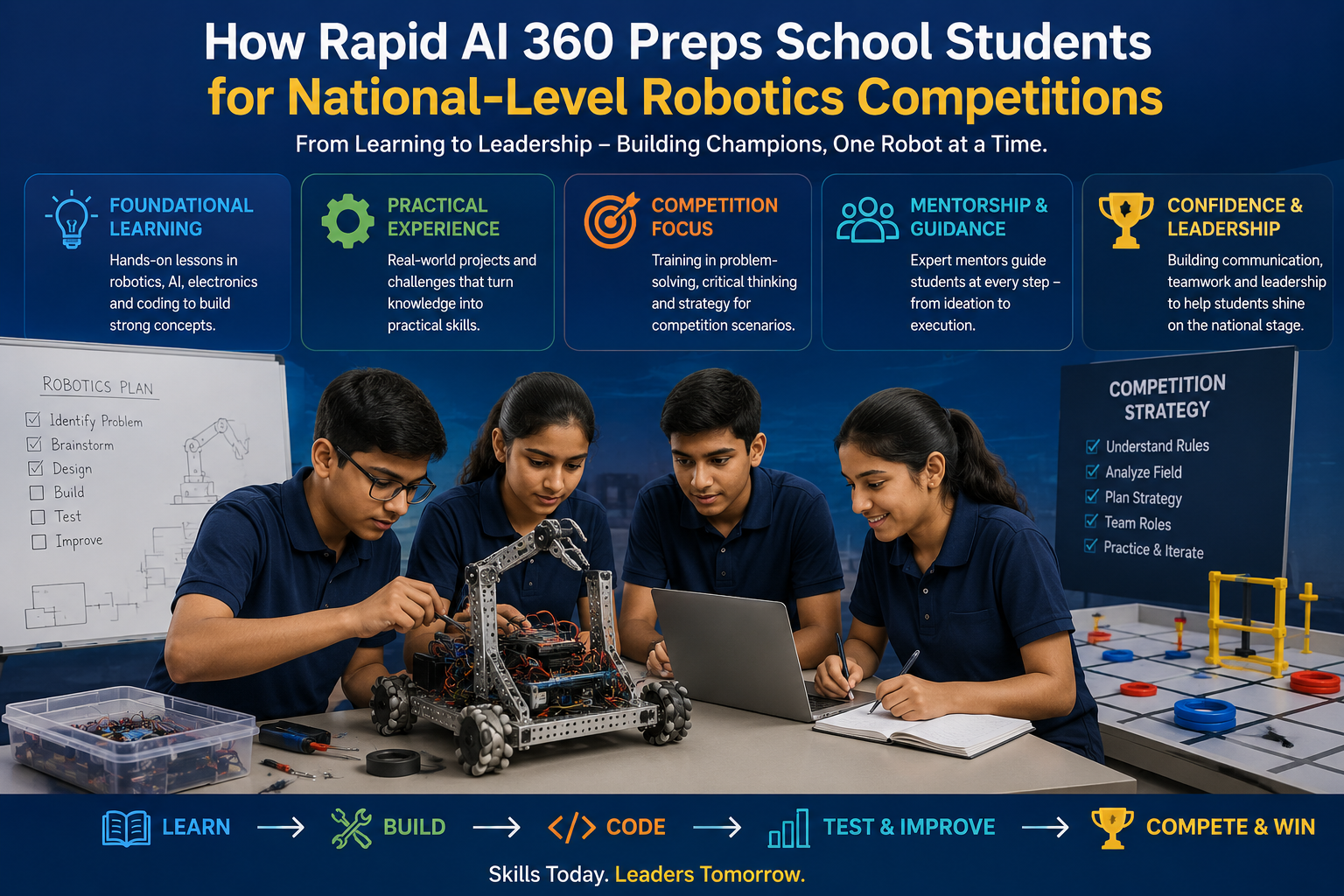
How Rapid AI 360 Equips Students for Competing in National Robotics Competitions
Education is only one aspect of teaching robotics at Rapid AI 360. Robotics instruction must be systematic and take students along the same path as actual engineers and inventors. Each step must be instruction-focused and tied to a definable goal.
Initial training and scaffolding are based on the fundamentals with the eventual goal of moving students to the level of competition and challenges.
Step 1: Instruction of the Fundamentals
Students must first learn the following concepts:
– Basics of robotics
– Basic and advanced mechanics
– Basic and advanced electronics
– Basic and advanced sensors and actuators
– Basic and advanced programming
– Basic Artificial Intelligence
– Basic STEM
With the fundamentals of the above stated concepts, students will then be able to tackle projects of increased difficulty.
Step 2: Execution of Projects
Students must execute a project for learning to have value.
Active participation and not passive observation is a key to students accomplishments and projects such as:
– Robots that follow lines
– Robots that avoid obstacles
– Automated smart parking systems
– Home automation systems
– Smart systems for agriculture
– Projects in the Internet of Things
– AI-enabled robotics
Each project that students accomplish fosters a belief in their accomplishments and builds a deeper understanding of technology and its application.
Step 3: Programming and AI
Contemporary robotics is reliant on both programming and Artificial Intelligence.
Rapid AI 360 introduces students to coding in an age-appropriate manner and helps students learn about the following topics:
– Programming logic
– Algorithms
– Sensor Integration
– Automation
– Machine intelligence
– Problem solving through coding.
Students understand that coding gives robots the ability to think and respond to their surroundings in a pattern-based and adaptive way.
Step 4: Design Thinking and Innovation
Winning robotics competitions require more than just an understanding of the technical aspects.
Students learn a specific type of structured thinking called Design Thinking, which involves solving complex, real-world challenges by learning about, defining, and presenting user-based problems and ideas in the form of a working prototype.
Practice for Competitions
Rapid AI 360 offers students opportunities to practice for competitions using a variety of challenge-based activities to prepare students for the real-world activities through simulated competition environments.
Students learn how to:
– Practice design and thinking under a time constraint
– Manage technical disruptions
– Collaborate
– Present and defend their work
– Design based on critique and improvement
This practice helps students focus and stay calm during real-world competitions.
Teachers and Mentors
Every successful student has benefited from the support and constructive feedback of a mentor.
The Rapid AI 360 program offers student support and mentorship through:
– Simplifying challenging concepts
– Promoting creative thinking
– Offering technical and conceptual support
– Guiding project work and presentation practice
Personalized mentorship and support moves students along their own learning pathway.
Robotics as an Extracurricular
Parents have concerns that extracurricular activities may have an impact on their child’s studies.
Robotics studies break that stigma, as most research and classroom activities have shown an overall improvement in student performance.
Robotics conveys disciplines integral to a student’s education:
Robotics fosters:
Robotics engenders a variety of skills from mathematics and science to computer studies, and even reading.
Beyond Winning Medals
While having an opportunity to win sponsored awards and gain recognition is great, the real benefits of participation are not in the certificates.
Students grow:
These characteristics remain for a lifetime and impact the student in school, after school, and beyond.
Robotics Opens Doors for New Careers
Through Robotics, students are able to envision a world where their careers can be in any of the many emergent job markets, such as:
Careers in Robotics Engineering
Careers in AI Engineering
Careers in Automation
Careers in Embedded Systems
Careers in the Internet of Things
Careers in Mechatronics
Careers in Aerospace
Careers in Product Design
Careers in Machine Learning
Careers as Research Scientists
The careers of students tomorrow can be based on the skills they learn today.
Parents Select Rapid AI 360
Parents are learning that today’s careers require more than just learning. Rapid AI 360 is designed to provide students with an opportunity to learn in an environment where they are able to explore, play, and innovate.
Benefits of Rapid AI 360:
STEM learning that is linked to industry
STEM learning that is hands on
STEM learning that is integrated with AI and Robotics
Coding from beginner to expert levels
Learning through competition
Learning through projects
Mentorship by a professional expert
Learning that is collaborative
Learning that fosters creativity and critical thinking
Learning that prepares students for the future
The goal is to not only prepare students to compete in robotics competitions, however, the goal is to prepare students for life.
Does Your Child Have an Interest in Robotics? Parent Checklist
Answer these questions to decide:
1. Does your child like to make things?
2. Do they wonder how machines and devices work?
3. Do they like to solve different types of puzzles?
4. Do they like science and technology?
5. Do they like to code and make things?
6. Would they rather learn by doing rather than reading?
If you said “yes” to most of these questions then learning robotics could be a great way to help your child discover their skills.
The Future of Technology and the Ability to Solve Problems
Every field from medicine to farming to how we get from one place to another to how we learn is being impacted by new technology.
The people who are at the forefront of these new developments all have the same ability.
They are all problem solvers.
Learning robotics provides children the ability to do all of the following:
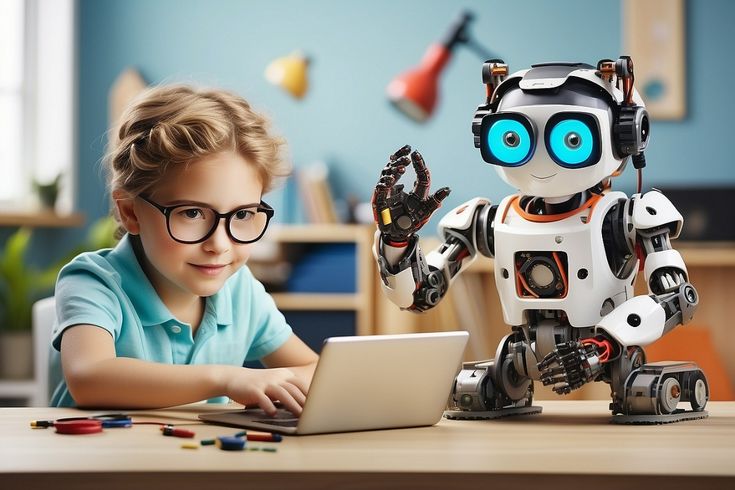
To identify a problem, create a possible solution, analyze their idea to see if it works, and think critically to improve it.
These skills will be invaluable for any problems they encounter due to new technology.
Final Thoughts
Participation in robotics competitions is a great way to help students gain confidence, give them the ability to think creatively, and help them learn the skills and techniques to solve problems.
With the ever increasing use of AI and automation in the workplace, learning robotics is one of the best ways to prepare students for new opportunities.
The goal of Rapid AI 360 is to help students learn in a structured, project-based way by integrating Robotics, AI, Coding, and STEM with Design Thinking. The program provides expert mentorship, first-hand experience, and preparation for competitions to help students turn their ideas into innovations.
Robotics is the perfect launchpad for future engineers, scientists, business moguls, and tech giants.
A technological future is inevitable, and those who mold and build it, rather than those who simply utilize it, will have the greatest place in society.
Give Your Child the Creative Edge
At Rapid AI 360, we know that all children can be innovators.
Our engaging programs in Robotics, AI, Coding, and STEM; IoT; and Design Thinking equip kids with the skills to compete in robotics competitions and the skills needed to thrive in future workplaces.
🚀 Book a FREE Demo Class now to see how Rapid AI 360 can equip your child with the skills to be a confident creator and problem-solver, and a potential tech leader.
1. What are student national robotics competitions?
These competitions are designed for students to build and program robots to solve a problem and compete with them. These competitions promote STEM and work-based learning skills.
2. What is the youngest age to learn robotics?
Children can learn the concepts of robotics in a child-friendly manner as early as elementary school.
3. What academic enhancement is there from learning robotics?
Robotics improves logical and creative thinking, science and math skills, communication, and teamwork, which all improve academic performance.
4. What are the advantages of robotics training at Rapid AI 360 for students?
Project-based learning, expert mentorship, AI-integrated robotics training, coding, and STEM education are all important. Rapid AI 360 also focuses on preparing students for competitions which, combined, empowers students with experience and confidence.