Introduction
AI is set to become the most disruptive technology of the 21st century. It has the power to change the world, just as the telephone and the Internet have done. Siri and Google Assistant and the widespread usage of fully autonomous vehicles and AI in medical diagnosis are just a few examples of how AI is changing the everyday relationship between humanity and technology.
The future will rely more and more on intelligent systems, automation, and data. AI has become an important technology to achieve the goals of efficiency, innovation, and the creation of greater value. Given its ability to learn, recognize patterns, and make predictions, AI will automate the future.
This article will examine the importance of AI to the future, the transformation that the different sectors of the economy and society will undergo because of AI, what AI will enable, what barriers it will create, and the reasons individuals and organizations must adopt AI today.
Understanding Artificial Intelligence
AI describes systems that are built to think like, learn like, and reason like humans. AI systems have the ability to understand and analyze data, recognize trends, and make decisions without the need for input.
Various modern technologies combined with artificial intelligence (AI) are:
– Deep learning
– Robotics
– Generative AI
– Predictive analytics
– Computer vision
– Naturallanguage processing (NLP)
– Machine learning
AI is extremely innovative and brings a lot of growth potential to businesses as it enables machines to perform advanced functions, including those that humans can do.
AI’s Rising Significance
With AI, it becomes easy to solve complex modern day problems by processing the enormous amounts of data that society generates daily. Every sector – business, government, healthcare, education, etc. – requires intelligent systems to assist them in the processing and analysis of data.
AI can do the following for organizations:
– Promote innovation
– Automate structure tasks
– Increase precision
– Decrease operating costs
– Improve user experience
– Increase productivity
Due to the rapid digital transformation, the potential of AI to assist organizations and the economy is only just beginning.
AI and the Future of Work
AI will have a transformative effect on every workplace.
Repetitive Task Automation
AI will facilitate the automation of tedious, time wasting tasks such as:
– Customer service
– Data entry
– Inventory management
– Report writing
– Scheduling
Employees will be able to redirect their efforts to higher order functions and tasks that require human collaboration.
Productivity Improvements
AI systems facilitate the automation of tedious tasks. Many organizations experience the improved operational performance and productivity that AI systems offer.
New Job Creation
While AI will make certain jobs redundant, it will also create new and different jobs.
Some of the AI-related careers that are rapidly growing include the following:
AI Engineer
Machine Learning Engineer
Data Scientist
AI Researcher
Robotics Engineer
AI Product Manager
Data Analyst
AI Consultant
The world will experience a constant increase in the need for skilled professionals as the application of AI becomes more widespread.
AI in HealthCare
Out of all industries, AI innovations are helping health care the most.
Early Detection of Diseases
AI can analyze data and detect diseases from medical images. Diagnosing diseases before they become more difficult to treat saves time and money for health care systems.
Personalized Treatments
AI helps design treatment plans tailored to a person’s history.
Drug Discovery
Researching and developing a new drug can take years and cost millions. AI can do this research and offer up new compounds to test that may work.
Virtual Health Assistants
AI can run chatbots that help answer health questions, set up appointments, and check patients.
AI in Health Care will help give patients the care they need, when they need it.
AI in Education
AI is dramatically changing the learning experience.
Personalized Learning
AI learning systems can adjust what students see to the learning system that works best for each student.
Intelligent Tutoring Systems
Virtual tutors can give immediate feedback and help students navigate difficult concepts.
Automated Grading
Assigning grades for tests and quizzes can be tedious for teachers. With AI, grading is done in real time, providing feedback for students faster.
Skill Development
AI can teach students to code, and learn about machine learning, robotics, and data science.
With the digital transformation of the education system, AI will play a significant role in developing the skills of students for the future.
AI in Business and Industry
For a competitive edge, all businesses invest in AI.
Customer Service
AI chatbots for 24/7 support increase customer satisfaction and decrease costs.
Marketing and Advertising
AI assists marketers to:
– Understand customer behaviors
– Anticipate buying behaviors
– Develop tailored campaigns
– Effectively allocatetheir ad spend
The net returns and interactions from campaigns improve.
Financial Services
To enhance efficiency, safety, and security, AI in banks aids:
– Fraud prevention
– Risk and assessment
– Credit score determination
– Automated trading
Manufacturing
Production can be disruptive and expensive, but with AI, Robotics, and Predictive Maintenance, the disruption is reduced, and the quality of production is increased.
AI is focused on the customer, and on improving the overall experience for the customer.
AI and Smart Cities
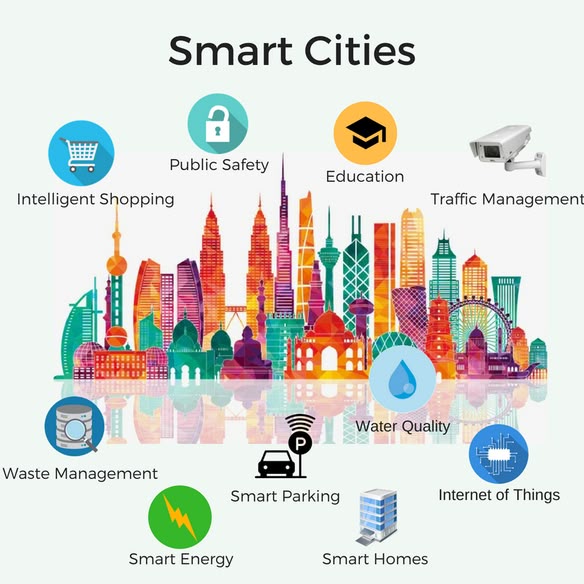
Increased urbanization makes city planning more challenging in the areas of transportation, energy, waste, and safety.
AI can make cities “Smart” with the following:
Traffic Management
AI can help improve transportation and ease congestion.
Energy Efficiency
“Smart” technology is AI in the service of energy management.
Waste
AI can help improve recycling and waste collection.
Public Safety
Security and emergency response systems benefit from surveillance and predictive analytics.
AI fuels smart cities, augments living standards, and cultivates sustainability.
AI in Agriculture
Agriculture is an additional industry reaping the rewards of AI investement.
Precision Farming
AI refines farming with weather, soil, and crop health analyses.
Crop Monitoring
Computer vision identifies pests and illnesses to mitigate their spread.
Resource Management
AI manages farming costs, fertilizer, and water investments.
Yield Prediction
The calculation of crop yield forecasts is aided by machine learning.
As AI cultivates sustainable growing practices for increasing global populations, agriculture is at the forefront of this movement.
AI and Cybersecurity

As the sophistication of attacks grow, lagging security practices struggle to keep up.
AI supports cybersecurity through:
– Behavior analysis
– Vulnerability detection
– Network surveillance
– Fraud prevention
– Threat response
Organizations focus their efforts on data protection with AI-based security infrastructure.
AI and Environmental Sustainability
AI is uniquely positioned and most notably utilized in defense of sustainability
Climate Monitoring
AI examines environmental data to anticipate climate alterations and their associated natural disasters.
Energy Efficiency
Smart systems can optimize energy use across residential and commercial settings.
Wildlife Conservation
AI can monitor endangered species and help prevent poaching and other illegal activities.
Waste Reduction
Artificial Intelligence is ideal to optimize supply chains for minimization of waste.
Sustainable practices will help with major environmental concerns and AI can help to do this.
The Role of Generative AI
One of the greatest advancements in technology, in the last few years, is Generative AI.
Generative AI Tools like ChatGPT, text to image, AI content generators, etc., are able to do many different things including:
– Text Generation
– Image Creation
– Video Generation
– Code Writing
– Graphic Design
Generative AI is impacting Education, Entertainment, Marketing, Software Development, Customer Service, and many other industries.
AI is making great advancements and will continue making great advancements.
Challenges and Ethical Considerations
Although AI technology has many great aspects, it brings the following challenges.
Data Privacy
When AI technology uses a lot of data to learn, concerns for data protection and privacy arise.
Bias and Fairness
There is a chance AI technology will unfairly reflect the biases that were in the data it learned from.
Job Displacement
There will be a need to learn new skills due to the displacement of jobs from automation.
Security Risks
Harmful activities can come from the misuse of AI technology.
Ethical Decision-Making
Transparent, fair, and responsible operations of AI systems can bring trust and good impact.
Why Students Should Learn AI Today
AI will help students to prepare for the jobs of the future.
Reasons to study AI include:
– More career opportunities
– Improved problem-solving
– More creative
– More employable
– Comprehend developing tech
Being AI literate will be as critical as being digitally literate.
Institutions that implement AI, ML, robotics, and cybersecurity in their curriculums will be equipping their students to be competitive in the future.
The Future of AI
The future of AI will continue to innovate and advance.
Predicted developments include:
– Self-driving cars
– Smarter robots
– Better health systems
– Tailored learning
– Better security
– Space travel
– Advanced energy
AI will keep developing and be further integrated into society and daily life. Businesses that early adopt AI will benefit greatly, and individuals who know AI will have many career options.
FAQs:-
1. Why is Artificial Intelligence important for the future?
Artificial Intelligence is important because it helps automate tasks, improve decision-making, increase productivity, and drive innovation across industries such as healthcare, education, finance, and manufacturing.
2. How will AI impact jobs in the future?
AI will automate some repetitive tasks, but it will also create new job opportunities in fields like Machine Learning, Data Science, Robotics, Cybersecurity, and AI development, requiring workers to develop new skills.
3. What industries will benefit the most from AI?
Industries such as healthcare, education, finance, retail, manufacturing, transportation, agriculture, and cybersecurity are expected to benefit significantly from AI through improved efficiency and smarter operations.
4. How can students prepare for an AI-driven future?
Students can prepare by learning AI-related skills such as programming, machine learning, data analysis, robotics, and problem-solving, while staying updated with emerging technologies and industry trends.
Conclusion
AI has the potential to disrupt many industries the same way the internet did, but the positive impacts of healthcare, education, business, agriculture, and environmental care will vastly outweigh the negatives.
AI is the best technology of our time due to its ability to streamline processes and improve efficiency. While privacy, ethical issues, and job displacement will be higher concerns, the positive impacts AI can and will bring to the world will be much higher.
Sooner or later, understanding and accepting AI will be inevitable. The world is progressively becoming more digital and interconnected. It does not matter what your occupation is, whether student, worker, owner of a start-up, or a CEO; the knowledge you invest in AI will be beneficial to you in the future. With technology developing with time, it is guaranteed you will prosper with this knowledge.